Canine Body Language Tips
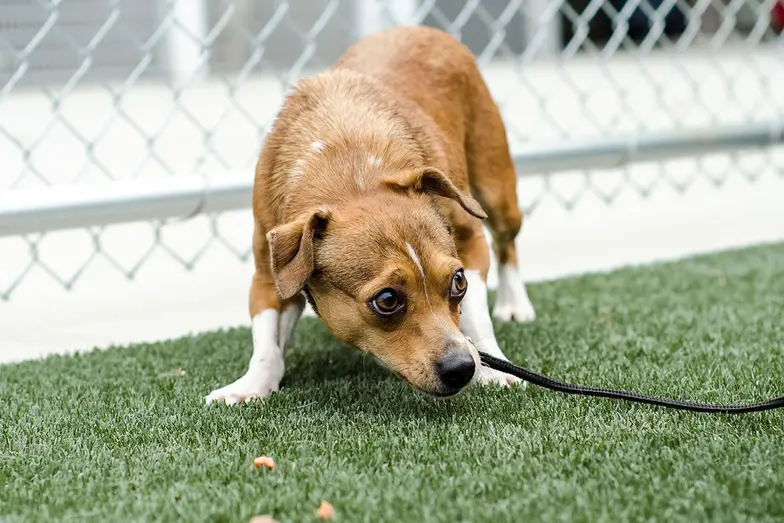
Know what to look for when handling dogs
Dogs communicate with one another and with us using their own elegant, non-verbal language. These tips focus on seven important aspects of a dog’s body: eyes, ears, mouth, tail, sweat and overall body posture/movement. While it’s valuable to examine the nuances of each part of the dog’s body, you’ll ultimately need to assess the dog as a whole and consider the current situation. Staff and volunteers can use this information to interpret what an animal may be feeling.
Eyes
When a dog is happy and relaxed, their eyes will be soft and open. A relaxed dog may also squint, so that their eyes become almond-shaped with no white showing at all. Slow blinking indicates a sense of trust and affection.
Partial eye closure can be a submissive gesture, signaling "I mean no harm," and would be paired with other submissive signals, such as a lowered head and body posture.
When a dog is feeling tense, their eyes may appear rounder than normal, or they may show a lot of white around the outside of the eye (the sclera), which is sometimes referred to as "whale eye.” You should also take into consideration the focus and intensity of the dog’s gaze. A still or frozen body position combined with an intense stare and tight facial muscles is a threatening display.
When a dog avoids making eye contact with a person or another dog, this can indicate discomfort, fear or avoidance.
Dilated pupils can be a sign of fear or arousal—making the eyes look "glassy" — indicating that a dog is feeling threatened, stressed, or frightened. In playful contexts, a dog’s pupils may dilate, too, but their playful intent will be supported by loose, bouncy body language.
Mouth
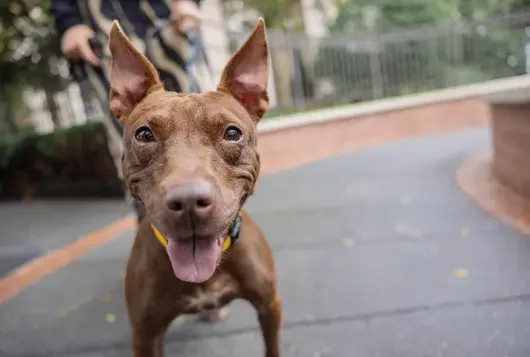
A relaxed dog will likely have their mouth open and may be panting, with no facial or mouth tension. The brow will be smooth, and the lips will be flat and free of wrinkles. The corners of their mouth may be turned slightly upward.
A fearful or tense dog will generally keep their mouth closed, and may pull their lips back at the corners (also known as a "long lip"). They may also be panting rapidly. A panting dog who suddenly closes their mouth in response to something in the environment may also be experiencing increased stress. Drooling when no food is present can also be a sign of extreme fear or stress.
A dog displaying a warning may wrinkle the top of their muzzle, often followed by a vertical pulling up of the lips to display their front teeth. This is called an "offensive pucker." The muzzle is wrinkled, and the corner of the mouth is short and forms a C-shape. This warning often comes with a tense forehead and hard, staring eyes. The dog may also growl—all very clear warnings to anyone approaching.
Some dogs display a "submissive grin" or smile, revealing their front teeth. But unlike a threatening display, the submissive grin is usually accompanied by a lowered head, wagging tail, flattened ears, a soft body posture, and soft, squinty eyes. Teeth don't always mean aggression—it is important to consider the whole body and the context to understand what a dog is saying.
Yawning and lip licking may be early signs of stress, particularly when accompanied by a tight mouth and averted gaze.
Ears
Dogs have a wide variety of ear types. Although it may be easier for us to see ear position in dogs with erect ears, even floppy-eared dogs like basset hounds can move the base of their ears forward and back to show different emotions—just look at the direction of the base of the ear. When a dog is relaxed, their ears may be positioned slightly back or out to the sides. As a dog becomes more aroused, the ears will move forward, pointing toward a subject of interest. When their ears are most forward, their foreheads often wrinkle.
When a dog’s ears are pinned tightly back against their skull (combined with things like body tension, tucked tail, lip licking, yawning, averted eyes, or “whale-eye”), that is a sign of stress, overwhelm, or fearfulness.
Tail
When observing a dog's tail, you first need to take into consideration their natural tail position. Some dogs, like Chow Chows and Shih Tzus, have tails that naturally curl upward and rest on their back. Other dogs, like sighthounds, naturally carry their tails low and slightly tucked. Thus, it is important to know a dog's natural tail carriage so you can easily identify when their tail changes from that natural position.
In most cases, a relaxed dog holds their tail in a neutral position, extending out from the spine or slightly below spine level. As the dog becomes more excited or aroused, their tail usually rises above spine level.
The tail's movement is also important to consider. A loose, wide wag from side to side (combined with other relaxed body language) indicates a relaxed, happy dog. A "helicopter tail," where the tail spins rapidly in circles, indicates friendliness, excitement, and joy.
As the dog becomes more excited or aroused, their tail usually rises above spine level. When the tail is held high with short, stiff, rapid movements, it is usually a signal of tension, high arousal, or potential aggression.
A fearful dog will tuck their tail between their rear legs. The tail may also be held rigid against the belly, or wag stiffly and in a low position.
Hair / FUR
Much like your own goosebumps, the hair along a dog’s back can rise when they are upset or aroused. This is also known as piloerection or raised hackles, and it can occur across the shoulders, down the spine, and above the tail. Hackles don’t always indicate aggression, but they are an indicator that the dog is excited or aroused.
A frightened or stressed dog may also shed more than usual or suddenly produce dandruff.
Sweat
Dogs pant to cool themselves, but rapid panting can also be a sign of stress, particularly when accompanied by a tight mouth, stress wrinkles around the mouth, and dilated pupils.
Dogs can also sweat through their paws. You may notice a dog leaving wet pawprints on the floor if they are particularly stressed.
Overall Body Posture and Body Movement
- When playful: When initiating play, dogs often start with a play bow and generally follow up with exaggerated facial and body movements. A playful dog's body will be loose, wiggly, and bouncy, with lots of movement and brief pauses during play.
A dog who seems stiff, moves slowly, or who keeps moving away may not be interested in social interaction with a playful dog. Looking away, sniffing, scratching, lying down, or other avoidance behaviors may also indicate a lack of interest in engaging in play.
- When aroused: When in a state of arousal, a dog may display a stiff body, rapid, tense wagging of the tail, dilated pupils, panting and high-pitched vocalization. In this state, a dog will have trouble listening, will show a lack of impulse control, and their excess energy may be displayed in the form of jumping, nipping, grabbing, spinning, digging or zoomies.
- When fearful: A fearful dog may look away, lean away, lean back, tremble, lower their body or head (to appear smaller), raise a paw, or roll onto their side or back. Often, their eyes will be fully open with large pupils, their foreheads wrinkled and their tails lowered or tucked.
An extremely fearful dog may freeze completely or frantically try to escape, and they may urinate or defecate when approached. If cornered or otherwise unable to avoid the threat, the dog may display defensive aggression. This display may include dilated pupils, whale eye, retracted lips, pulled-back ears, lowered body posture, tucked tail, stiff body, and if a snap or bite occurs, it is usually a single strike followed by a quick retreat.
- When aggressive: A dog displaying offensive aggression will look large, standing with their head raised above their shoulders. Their body will be tense, with weight either centered over all four paws or leaning slightly forward onto the front legs. The dog may also have a wrinkled muzzle, a short lip, ears pointed forward and a hard, focused gaze.
More Lifesaving Resources
We have lots more on this subject: